AI Content Detection Is Changing. Your Content Strategy Should Too.
For years, marketers have debated whether Google can detect AI-generated content, but that conversation may be about to change.
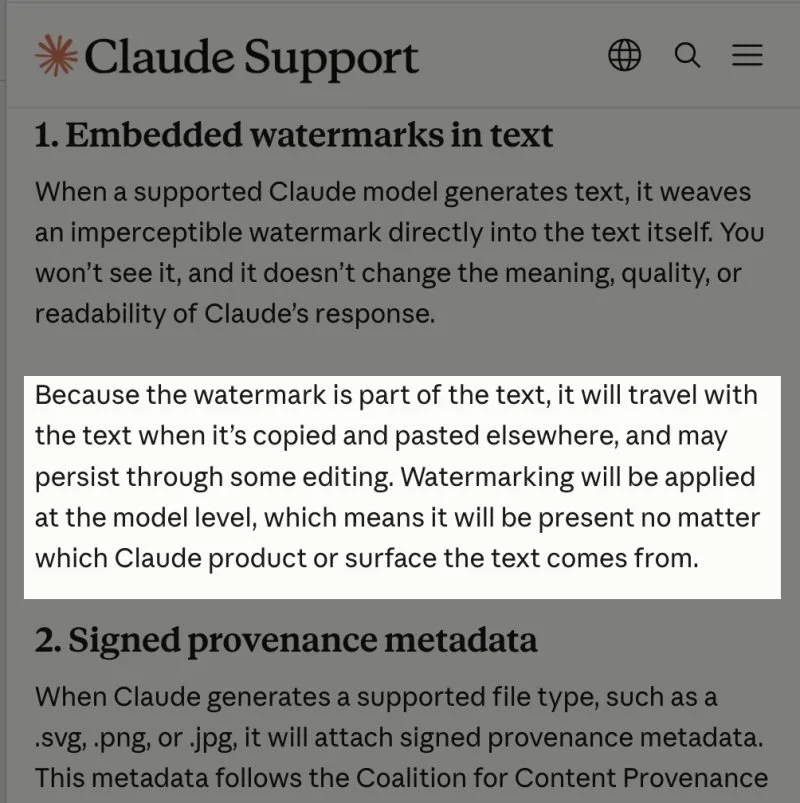
Anthropic has announced that text generated by its Claude models will include an embedded watermark designed to remain with the content when it is copied and pasted. Users will not see the watermark, but machines potentially will.
Anthropic says the move is intended to improve transparency around AI-generated content and support compliance with regulations such as the EU AI Act.
For marketers and SEO professionals, the bigger question is what happens next.
AI Content Could Become Easier to Identify
Today, many AI-content detection systems attempt to determine whether something was generated by AI based on linguistic patterns, statistical probabilities, and other characteristics of the writing. Those systems aren't perfect.
A watermark could potentially provide a fundamentally different approach. Instead of trying to determine whether a piece of content looks like it was created by AI, a system could potentially identify a signal associated with the model that generated it.
Anthropic has also indicated that it plans to work with users and third parties on ways to interpret the watermark, with technical documentation to follow.
Google hasn't been specifically identified as a partner, but it's easy to understand why search engines could be interested in technology that makes AI-generated content easier to identify at scale.
And if Anthropic is moving in this direction, other AI companies may eventually consider similar approaches.
But AI Isn't the Real Problem
Here's where I think marketers need to pay attention. The biggest threat isn't AI-generated content, it's mediocre content.
AI can be incredibly valuable for marketers. It can help teams research faster, generate ideas, repurpose existing content, analyze information, develop outlines, and dramatically accelerate production. But the problem occurs when efficiency becomes the strategy.
If your process is simply: Prompt → Generate → Publish you're not building a content strategy, you're building a content factory. And content factories are about to become increasingly difficult to differentiate.
The Competitive Advantage Is Expertise
As AI makes generic content easier and cheaper to produce, the value of original information increases.
That means brands should focus more heavily on the things AI cannot manufacture from nothing:
Original research
Firsthand experience
Proprietary data
Customer insights
Expert opinions
Strong points of view
Unique processes and frameworks
Demonstrated results
AI should help your team amplify those assets, not replace them.
The question shouldn't be, "How do we make this content look less like AI?" The better question is: "What can we say that demonstrates why our brand deserves to be trusted?"
Now that's a much more valuable marketing question.
The Future of SEO Is About Value
Search is evolving.
Google is evolving.
AI-powered search and answer engines are changing how people discover information.
As that happens, simply producing more content isn't going to be enough. The brands that stand out will be the brands that consistently demonstrate expertise, originality, credibility, and usefulness.
AI may make content easier to create, it doesn't make valuable expertise easier to manufacture.
The future of SEO isn't about hiding that you used AI. It's about making sure there's something worth finding in the first place.