For years, businesses have relied on traditional analytics platforms to understand how customers find them online. Google Analytics, Search Console, and other marketing tools have made it possible to track website traffic, keyword performance, impressions, and conversions.
But as more consumers turn to ChatGPT and other AI platforms to research products, compare services, and find businesses, a new challenge has emerged:
How do you measure whether your business is actually showing up in AI-generated answers?
ChatGPT appears to be working on a solution.
Introducing AI Visibility Analytics
OpenAI is developing an analytics feature designed to help businesses understand how frequently they are mentioned in ChatGPT conversations and whether those mentions generate website traffic.
The feature focuses on two primary performance metrics:
Impressions: The number of times a business appears in ChatGPT-generated responses.
Clicks: The number of times users click links within those responses to visit the business's website.
Both metrics are tracked daily and presented in a visual performance chart, giving businesses a clearer picture of their visibility and referral traffic from ChatGPT.
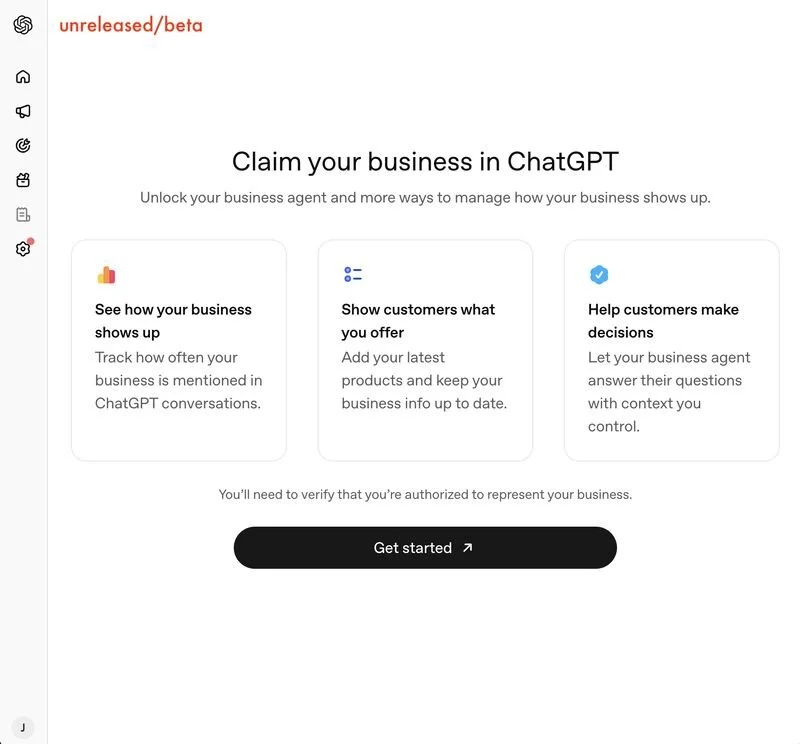
I've been following signs of this development since August, but a new banner recently appeared suggesting the feature may be getting closer to launch.
It appears to be part of a broader Business Hub experience, with access tied to business ownership verification. Integrations such as connecting a Shopify store may be one way businesses establish that verification.
What Will This Analytics Tool Actually Tell You?
The biggest opportunity is the ability to measure AI visibility using first-party data.
Until now, businesses and marketers have largely depended on third-party platforms to estimate how frequently brands appear in AI-generated responses. Those tools can monitor prompts, citations, brand mentions, and competitive visibility, but they don't necessarily provide direct performance data from the AI platform itself.
ChatGPT's proposed analytics could help close that gap.
However, there are some important limitations.
The feature does not appear to provide access to:
The specific prompts users enter.
Individual user information or conversation history.
Competitor visibility benchmarks.
Comparative brand rankings.
That means businesses will know whether their visibility is increasing or decreasing, but they won't necessarily understand what is driving those changes.
Why This Matters for GEO and AEO Strategies
This is where things get interesting for marketers.
Generative Engine Optimization (GEO) and Answer Engine Optimization (AEO) are becoming increasingly important as consumers change how they discover and evaluate businesses.
Traditional SEO focuses heavily on earning visibility in search engine results. GEO and AEO expand that approach to include earning mentions, citations, and recommendations within AI-generated answers.
But visibility without measurement makes optimization difficult.
By combining ChatGPT's first-party analytics with external AI monitoring tools, marketers could develop a much more complete picture of performance.
For example, external tools could identify which prompts generate brand mentions, which competitors appear alongside your business, and which sources AI platforms reference. ChatGPT's analytics could then help validate whether that visibility is translating into impressions and website clicks.
Together, these insights create a stronger measurement framework for AI-driven discovery.
The Next Evolution of Digital Marketing Measurement
AI search is changing how businesses get discovered. Naturally, the way we measure marketing performance needs to evolve alongside it.
ChatGPT's analytics feature is still a work in progress, and its final capabilities and availability remain to be seen.
But the direction is encouraging.
We're moving beyond simply asking whether AI platforms know your brand exists.
The next question is whether AI visibility is generating meaningful exposure, website traffic, and ultimately, business growth.
For businesses investing in SEO, GEO, and AEO, that distinction matters.