Google Ask Maps: How Local Businesses Can Become Easier for AI to Recommend
Local search is changing. Customers have traditionally searched Google for businesses, compared listings, read reviews, and visited websites before making a decision. Now, AI-powered search experiences are making it possible to describe a specific need and receive recommendations tailored to that situation.
Google Ask Maps represents this shift. By bringing conversational AI into Google Maps, Google is making it easier for people to discover places and businesses based on what they want to accomplish, not just the keywords they enter.
For local service businesses, including contractors, HVAC companies, plumbers, electricians, and auto repair shops, this creates a new opportunity to improve visibility and attract qualified customers.
The goal is no longer simply to rank for a high-volume keyword. Businesses must also make it easy for Google to understand their services, capabilities, reputation, and relevance to a customer's specific needs.
Here's what local businesses need to know about Google Ask Maps and how to prepare for the future of local SEO.
What Is Google Ask Maps?
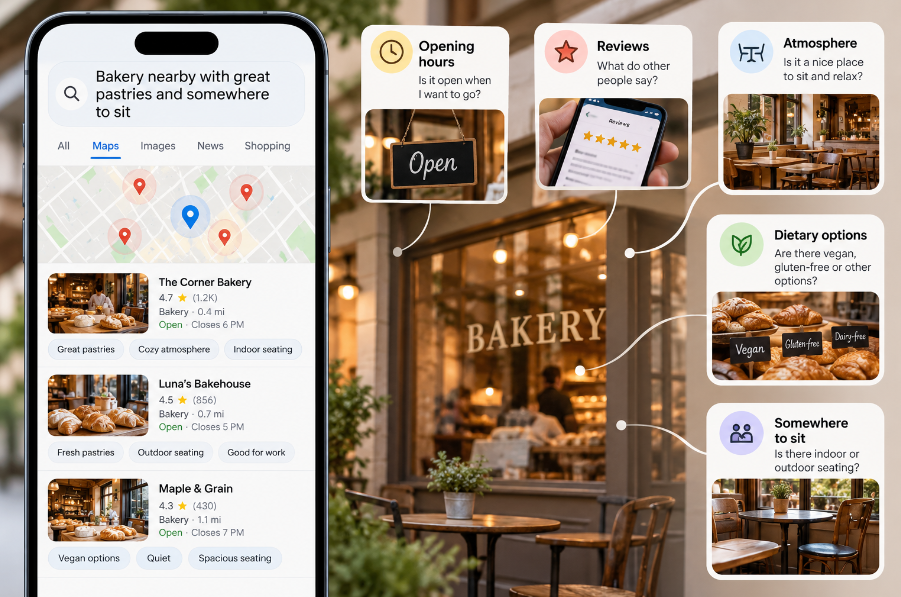
Google Ask Maps is a conversational search experience within Google Maps that uses Google's Gemini AI to help people explore places and find relevant recommendations.
Instead of searching for a broad term such as "plumber near me," a customer might ask, "Which plumber can fix a leaking water heater today?"
That question requires more context than a traditional keyword search. The customer wants a nearby provider, but also needs someone who handles water heater repairs and may be available quickly.
Google can use information about businesses, places, reviews, and other relevant context to help identify potential matches.
This represents an important development in local discovery. Businesses must communicate more than their location and primary service category. They need an accurate, detailed online presence that helps search systems understand what they do and whom they serve.
For business owners, the opportunity is to become a more relevant and credible option when customers describe the problems they need to solve.
1. Optimize for Customer Intent, Not Just Keywords
Traditional local SEO often focuses on keywords such as "roofing company in Orlando" or "HVAC repair near me." These terms remain valuable, but conversational search introduces more specific customer requirements.
Consider these examples:
Traditional search: "Electrician near me."
Conversational search: "Who can troubleshoot a breaker that keeps tripping?"
Traditional search: "Auto repair shop."
Conversational search: "Which mechanic can diagnose a check-engine light?"
Traditional search: "Roofing contractor."
Conversational search: "Who repairs storm damage and offers emergency roofing services?"
Each conversational query communicates a problem, an expectation, or a qualification.
Local businesses should identify the questions customers ask before contacting a provider. Sales conversations, customer reviews, website search data, frequently asked questions, and service inquiries can all reveal useful insights.
Use those insights to strengthen service pages, Google Business Profile descriptions, and supporting content.
The objective is not to insert every possible question into your website. It is to communicate your services clearly enough that customers and search systems can determine whether your business is a suitable match.
2. Make Your Google Business Profile More Informative
Your Google Business Profile remains a foundational asset for local SEO. It helps Google understand your business and gives potential customers essential information when evaluating local providers.
However, a profile that contains only a business name, address, phone number, and basic category may not communicate the full range of your capabilities.
Review your profile and make sure it includes:
Accurate primary and secondary business categories.
Complete service listings and descriptions.
Current operating hours and holiday schedules.
Correct service areas and contact information.
Relevant business attributes.
High-quality photos that represent your work.
Consistent information across your website and other business listings.
For example, an electrical contractor should clearly communicate whether it handles residential electrical repairs, panel upgrades, lighting installations, or emergency service, where applicable.
Specific, accurate information helps potential customers understand what the company offers. It also gives search systems more context when evaluating local business relevance.
Keep your information updated as services, hours, and service areas change. Accuracy is more valuable than adding details that the business cannot substantiate.
3. Turn Customer Reviews Into a Competitive Advantage
Customer reviews are an important part of local visibility and reputation management. They also provide valuable insight into how customers describe their experience with a business.
Look beyond the overall star rating. Identify recurring themes in the language customers use when discussing your company.
Customers might frequently mention:
Fast response times.
Professional technicians.
Clear communication.
Transparent pricing.
Reliable scheduling.
Quality workmanship.
Convenient appointment availability.
These recurring themes can help differentiate your business from competitors.
For example, if customers consistently praise your technicians for explaining repairs clearly, that may be a meaningful positioning advantage. You can reinforce that strength on your website, in marketing materials, and in service descriptions.
Encourage customers to share honest feedback about their experiences, and respond professionally to positive and negative reviews.
Never manufacture reviews or pressure customers to include specific keywords. Authentic feedback provides a more credible foundation for reputation management and customer trust.
4. Build Website Content Around Real Customer Questions
Your website should help potential customers determine whether your business can solve their problems.
Generic statements such as "We provide reliable, high-quality service" do little to explain what makes a company the right choice.
A more useful HVAC service page might explain whether the company offers same-day AC repairs, which equipment it services, what areas it covers, and how customers can schedule an appointment.
Similarly, a roofing contractor could clarify its experience with roof inspections, storm damage, leak repairs, replacement projects, and emergency calls.
Effective service pages should answer questions such as:
What services do you provide?
Which problems can you solve?
What locations do you serve?
What experience or qualifications support your expertise?
What should customers expect during the process?
How can customers request an estimate or appointment?
Use clear headings, descriptive language, and straightforward explanations. Create dedicated pages for distinct services when there is enough useful information to justify them.
This approach supports traditional SEO while making your content more useful for people researching businesses through AI-powered search experiences.
The priority is clarity, specificity, and demonstrated expertise, not publishing large volumes of repetitive content.
5. Connect Local Visibility to Actual Business Results
Being recommended by a search platform is valuable only when that visibility helps the business achieve meaningful outcomes.
Once a potential customer discovers your company, the next step should be easy.
Make sure your phone number works, appointment options are clear, service information is accurate, and contact forms function properly. Remove unnecessary friction from the process of requesting service.
Businesses should also measure performance beyond rankings and profile views.
Track relevant metrics such as:
Qualified phone calls and website inquiries.
Appointment requests and booked jobs.
Google Business Profile interactions.
Direction requests and other relevant local actions.
Website organic traffic and conversion rates.
Lead quality and cost per qualified lead.
Where available, use Google Analytics, Google Search Console, Google Business Profile performance data, and your CRM to understand how discovery translates into leads and revenue.
As conversational search develops, direct attribution may remain difficult. Ask Maps visibility should therefore be evaluated alongside broader local search performance rather than treated as an isolated source of guaranteed leads.
6. Build a Practical Local SEO Strategy for AI Search
Businesses do not need to abandon their existing SEO strategies to prepare for Google Ask Maps. They should strengthen the fundamentals and make their information more useful.
Start with a Google Business Profile audit. Confirm that categories, services, hours, contact details, and service areas are accurate.
Next, analyze customer questions and review feedback to identify the problems your audience wants to solve.
Then, update your website's core service pages to address those needs with specific, trustworthy information. Check that your business details remain consistent across relevant directories and citations.
Finally, test representative conversational searches in Google Maps where Ask Maps is available. Compare the businesses that appear with your own online presence, paying attention to differences in service coverage, reviews, profile completeness, and content quality.
Use these observations to identify improvement opportunities, not as proof that any single factor determines AI recommendations.
Conclusion: Make Your Business Easier to Understand and Recommend
Google Ask Maps highlights an important evolution in local search. Customers increasingly want answers that reflect their circumstances, preferences, and immediate needs.
For local businesses, this reinforces the importance of accurate business information, strong customer reviews, helpful website content, and a frictionless conversion process.
Traditional local SEO remains essential. However, businesses should also consider whether their online presence clearly explains what they do, which customers they serve, and why they are a credible choice.
The most effective strategy is not to chase every new AI feature or optimize for hypothetical questions. It is to build a complete, trustworthy digital presence that serves customers well across search experiences.
The key question for every local business is simple: When a customer explains the problem they need solved, does your online presence give Google enough accurate information to understand why your business belongs in the conversation?
Answer that question with a stronger Google Business Profile, better service pages, authentic reviews, and measurable conversion improvements, and you will be better positioned for the continuing evolution of local search.