How AI Is Making Your Content Sound Like Everyone Else
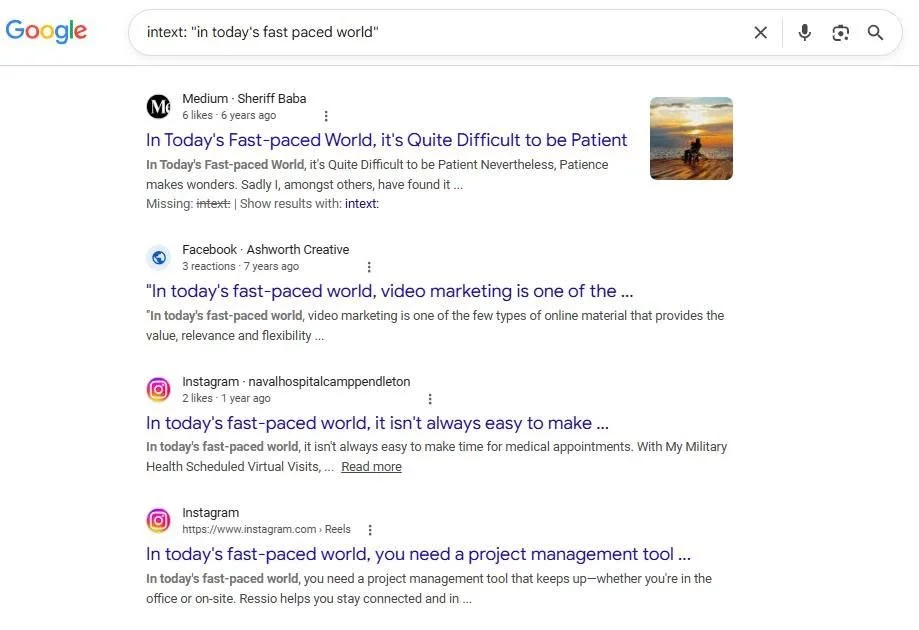
I recently searched Google for one simple phrase: "In today's fast-paced world..." and the results were exactly what I expected, but still surprising.
Hundreds of blog posts. Landing pages. Social media posts. Marketing emails. Website copy. Different industries. Different businesses. Different audiences. The exact same opening. It's become one of the most recognizable signs of AI-generated content. The phrase itself isn't the problem. The problem is what it represents.
Why AI Keeps Writing It
Whether you're using ChatGPT, Claude, Gemini, or another large language model, "In today's fast-paced world..." is one of the most common introductions AI generates when prompts lack enough context, direction, or a unique perspective.
AI is designed to predict the next most likely word based on patterns it has learned.
That phrase is one of those patterns.
If thousands of marketers ask AI to "write a blog post about marketing" or "create a LinkedIn post," many will receive nearly identical introductions because they're all starting with generic prompts.
The result is content that feels interchangeable.
Your Audience Notices More Than You Think
Consumers are becoming remarkably good at recognizing AI-generated writing.
Not because they can identify the technology behind it, because they've seen the same writing style over and over again.
Generic introductions.
Predictable transitions.
Safe opinions.
Overused phrases.
The moment readers encounter language they've seen dozens of times before, they begin making assumptions.
"This wasn't written for me."
Whether that's actually true almost doesn't matter, perception shapes trust. If your content sounds like everyone else's, your brand becomes forgettable before readers reach the second paragraph.
Give Readers a Reason to Keep Reading
Instead of opening with a cliché, capture attention immediately.
Start with a customer problem they recognize.
Share a surprising statistic or insight.
Take a bold position that challenges conventional thinking.
Tell a real story from your own experience.
Or promise a specific outcome your audience wants to achieve.
Those openings feel human because they are rooted in experience, observation, and perspective instead of pattern recognition.
AI Should Amplify Your Expertise, Not Replace It
Some people worry AI will replace great writers, I think the opposite is happening. AI is exposing average writing.
The businesses that will win with AI won't be the ones producing the most content, they'll be the ones producing the most distinctive content.
The companies that stand out will use AI to organize ideas, accelerate research, improve clarity, and refine messaging, while keeping their expertise, opinions, and personality at the center of everything they publish.
That's the difference between using AI as a shortcut and using it as a strategic advantage.
Your Voice Is Still Your Greatest Competitive Advantage
AI is an extraordinary writing assistant, It can help you brainstorm faster, edit more efficiently, and overcome creative blocks.
But it cannot replace the one thing your competitors can never duplicate.
Your experience.
Your insights.
Your stories.
Your point of view.
The future of content marketing doesn't belong to businesses that sound the most like AI, it belongs to businesses that use AI to sound even more like themselves.