Businesses have typically always struggled to answer a simple question: Is our brand actually showing up in AI-generated search results, and is that visibility producing measurable results?
With the growing popularity of ChatGPT, Gemini, Perplexity, and other AI-powered platforms, traditional SEO reporting is no longer telling the complete story. Website rankings, organic traffic, and keyword performance remain important, but they don't necessarily reveal how often a business is being recommended in AI-generated responses.
That may be about to change.
ChatGPT is developing a new analytics feature designed to help businesses measure how frequently they appear in ChatGPT responses and how often users click through to visit their websites.
Think of it as first-party analytics for AI search. And it could represent an important step forward in understanding the business impact of AI visibility.
What Is ChatGPT Analytics?
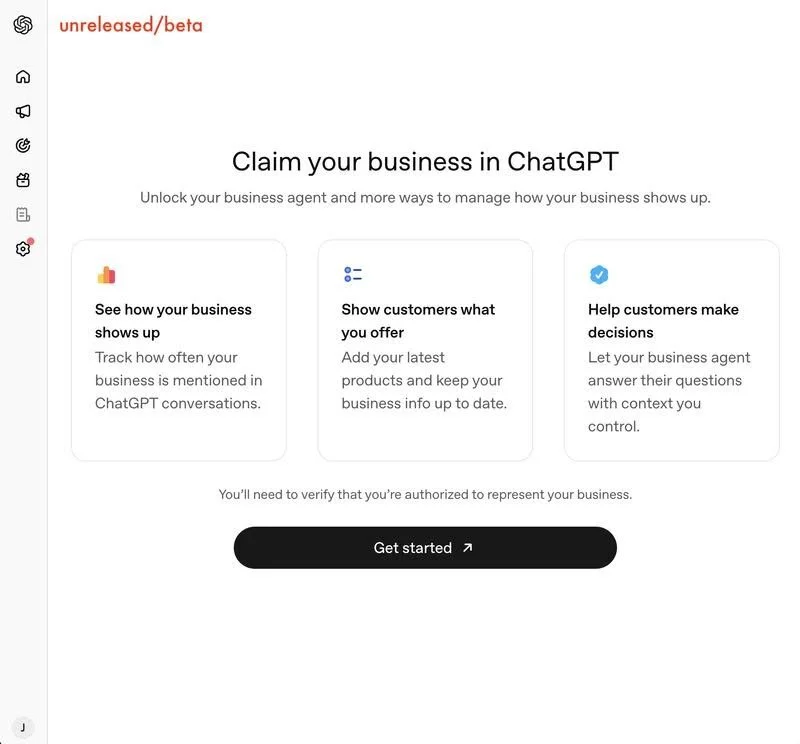
The new feature is expected to become part of a broader ChatGPT Business Hub experience, giving verified businesses access to performance data about their visibility within ChatGPT conversations.
Signs of this development have been appearing since August 2026. More recently, users noticed a new banner suggesting the feature may be getting closer to launch.
While the final rollout details remain unconfirmed, the concept is straightforward. Businesses will be able to see how frequently ChatGPT mentions their brand and whether those mentions generate website traffic.
The feature is expected to focus on two primary performance metrics:
1. Impressions
Impressions will measure how many times a business appears in ChatGPT responses.
This is important because consumers increasingly use AI platforms to research products, compare services, find recommendations, and make purchasing decisions.
A business might be receiving significant exposure through ChatGPT without generating a corresponding increase in traditional organic search traffic.
Impression data could help reveal that previously hidden visibility.
2. Clicks
Clicks will measure how many times users click links within ChatGPT responses to visit a business's website.
This is arguably the more interesting metric.
Being mentioned in an AI-generated response is valuable, but visibility alone doesn't necessarily translate into business results.
Clicks provide another layer of insight by showing whether AI recommendations are encouraging users to take the next step.
Both metrics are expected to be tracked daily and displayed through a visual performance chart, allowing businesses to monitor changes over time.
What ChatGPT Analytics Won't Tell You
While this development is exciting, businesses need to understand its limitations.
The analytics feature is not expected to provide complete visibility into how ChatGPT generates its recommendations.
For example, businesses should not expect access to:
The specific prompts users enter into ChatGPT.
Individual user information or conversation histories.
Competitor performance or visibility metrics.
Rankings showing where a business appears compared to competitors.
Detailed explanations of why visibility increases or decreases.
In other words, the feature may tell you how often your business appears and how many clicks those appearances generate, but it won't necessarily explain what caused those results.
That's an important distinction.
Impressions and clicks provide valuable performance data, but they don't replace the research and analysis required to understand your overall AI search presence.
Why This Matters for SEO, GEO, and AEO
Traditional SEO has historically focused on improving visibility in search engine results pages, generating organic traffic, and converting visitors into customers.
AI search introduces another layer.
Consumers are increasingly asking platforms like ChatGPT to recommend businesses, explain services, compare providers, and answer questions before they ever visit a website.
This creates a new visibility challenge for businesses.
Your company could be recommended in an AI-generated answer without receiving a website visit. That exposure may influence purchasing decisions even when traditional analytics platforms never register a click.
This is where Generative Engine Optimization (GEO) and Answer Engine Optimization (AEO) become increasingly important.
Businesses need to understand not only whether their websites rank in traditional search results, but also whether AI platforms recognize, reference, and recommend their brands.
ChatGPT's developing analytics capabilities could help bridge that measurement gap.
Combining First-Party Data With AI Visibility Tools
The real opportunity isn't simply having another analytics dashboard.
It's combining ChatGPT's first-party performance data with external tools that monitor AI visibility.
For example, businesses can use third-party platforms to track:
How frequently their brand appears in AI-generated answers.
Which prompts and questions trigger brand mentions.
Which websites and publications AI platforms cite.
Which competitors appear in relevant conversations.
How brand visibility changes across different AI platforms.
When combined with ChatGPT's impression and click data, these insights can provide a much clearer picture of AI search performance.
You can begin connecting your optimization efforts to measurable outcomes.
Are your content investments increasing brand mentions? Are authoritative third-party citations helping establish credibility? Are your GEO and AEO strategies generating more visibility? And most importantly, is that visibility driving qualified website traffic?
These are the questions businesses should be asking.
The Future of Measuring AI Marketing Performance
AI search is changing how consumers discover and evaluate businesses. Marketing measurement needs to evolve alongside it.
For now, ChatGPT's developing analytics feature is an encouraging step toward making AI visibility more measurable. It won't answer every question, and businesses will still need external monitoring tools to understand the bigger picture.
But it introduces something the industry has been missing: a potential first-party measurement system for brand exposure and website traffic generated through ChatGPT.
The bigger takeaway is that AI visibility should no longer be treated as an abstract marketing metric.
Businesses need to understand where they appear, how frequently they're recommended, and whether those recommendations influence customer behavior.
We're moving beyond asking whether AI is mentioning your brand. We're getting closer to measuring whether that visibility is actually generating traffic.
And that's a significant shift in how businesses will approach SEO, GEO, AEO, and digital marketing moving forward.