Google Is Warning Businesses: Don’t Manufacture Expertise With AI
AI has made it easier than ever to create content. It’s also made it easier than ever to manufacture the appearance of expertise and that’s becoming a problem.
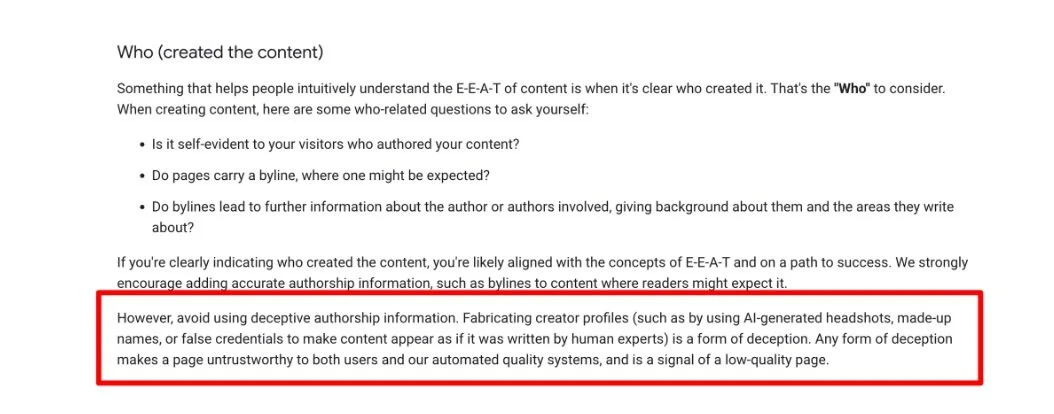
Google has recently warned against using fake author information on content, including fabricated author identities, fake credentials, and AI-generated images representing nonexistent experts. The issue isn't simply whether a company used AI to create an article. The bigger issue is whether the company is deceiving users about who created the content and why that person should be trusted.
That distinction matters.
AI Content Isn't the Problem. Fake Authority Is.
Businesses can use AI to help research, outline, draft, edit and improve content.
The problem begins when AI is used to create artificial credibility.
For example, imagine a roofing company publishes an article attributed to: "Michael Thompson, Certified Roofing Specialist, 25 Years of Experience."
The article includes a professional-looking headshot, a detailed biography and impressive credentials, but there’s just one problem.
Michael Thompson doesn't exist.
That isn't an SEO strategy, it's manufactured authority. Google's warning makes it clear that deceptive authorship can contribute to a page being viewed as untrustworthy or low quality. And that should concern marketers because trust is becoming increasingly important across search.
Why This Matters for SEO
For years, marketers have focused on E-E-A-T: experience, expertise, authoritativeness and trustworthiness.
That led some businesses to treat author bios as another SEO checkbox.
Add a name.
Add a photograph.
Add credentials.
Add an author page.
Done.
But E-E-A-T isn't something you can manufacture simply by adding the right words to a webpage.
A legitimate author should actually exist. Their credentials should be accurate. Their experience should be relevant. And the content should demonstrate genuine knowledge.
In other words: Don't fake E-E-A-T.
Google isn't simply evaluating whether a page says someone is an expert. The larger question is whether the content itself demonstrates evidence of expertise and trustworthiness.
The AI Search Connection
This becomes even more important as search continues to evolve. People are increasingly asking ChatGPT, Gemini, Perplexity, Google and other AI-powered search experiences for recommendations and answers. Those systems don't just need information. They need signals that help determine whether information is credible.
Who created it?
What experience do they have?
Does the organization actually do what it claims to do?
Is the information supported by other credible sources?
Does the content contain original information or simply repeat what everyone else is saying?
Manufactured author profiles don't solve those questions. In fact, they can create another layer of distrust.
The Real Competitive Advantage Is Experience
This is where legitimate businesses have an enormous advantage.
A contractor has completed projects.
A mechanic has diagnosed thousands of vehicles.
A roofer has seen real roofing failures.
A manufacturer has engineering knowledge.
A doctor has clinical experience.
A marketing strategist has actually run campaigns and seen what works.
That real-world experience is incredibly valuable in an environment where generic AI-generated content is becoming almost limitless.
The opportunity isn't to produce more generic content, it's to turn real experience into content.
Instead of asking AI to write a generic article about roofing problems, a roofing company could provide:
Common problems their technicians see
Mistakes homeowners make
Photos from completed projects
Lessons from difficult repairs
Customer questions
Regional weather considerations
Original data
Case studies
Expert commentary
AI can then help organize, refine and distribute that knowledge.
The expertise comes from the business. AI simply helps scale it.
A Better AI Content Model
The traditional content model looked something like this: Keyword → AI article → Fake author → Publish
That approach is becoming increasingly risky.
A better model is: Real expertise → Original insight → AI-assisted production → Human review → Authentic author → Publish
That distinction is important.
AI should be the production assistant, not the source of manufactured authority.
Your subject matter experts should provide the knowledge.
Your marketing team should provide the strategy.
AI can help turn that knowledge into useful content.
And a human should review the final product for accuracy, context and credibility.
Don't Manufacture Authority. Amplify It.
Google's warning about fake author information is part of a larger shift in how businesses should approach content.
The question is no longer: "How much content can we publish?"
The better question is: "What can we publish that proves we actually know what we're talking about?"
That’s a much harder question for AI-generated content farms to answer. It’s also an enormous opportunity for legitimate businesses.
Your competitive advantage isn't having access to AI.
Everyone has access to AI.
Your competitive advantage is the knowledge, experience, data, opinions and real-world results that AI doesn't have on its own.
Use AI to amplify that expertise. Don't use it to manufacture expertise that doesn't exist.
Because the future of SEO and AI search won't simply belong to the businesses producing the most content.
It’ll increasingly belong to the businesses that can prove they deserve to be trusted.