How Long Does SEO Take? Google Reveals How Search Actually Works.
If you've ever asked, "How long does SEO take?", you're not alone. It's one of the most common questions business owners and executives ask when investing in SEO. But the problem is that there isn't one answer.
Google Search isn’t a single system that immediately processes a change after you publish a page or update your website. It is a collection of systems that discover, crawl, render, index, evaluate, and ultimately serve content.
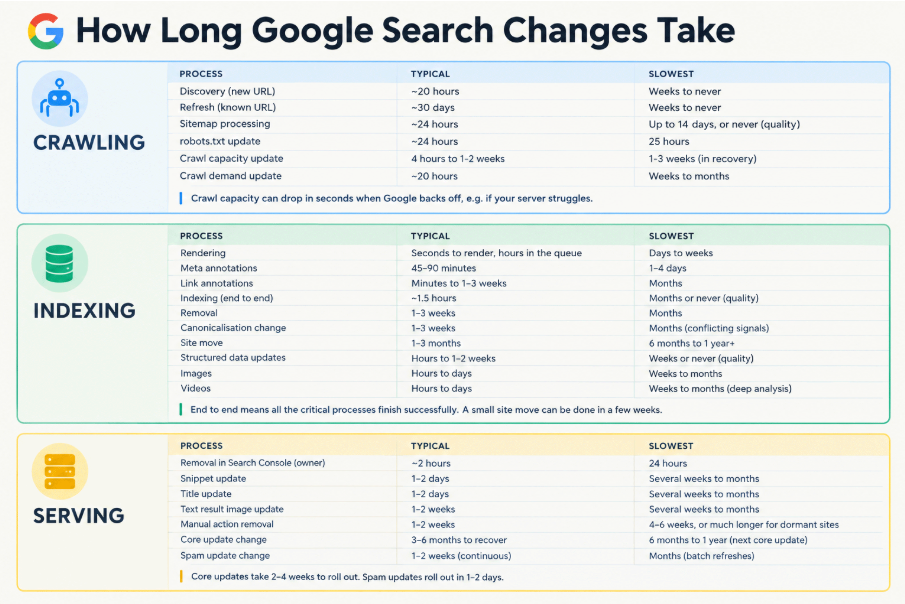
Recent data shared by Google provides some useful insight into just how long these processes can take.
And the biggest lesson is simple: SEO is a process, not a switch you turn on.
Google Search Works in Stages
When you publish or update a page, several things have to happen before you see an impact in search results.
The general process looks something like this:
Publish → Discover → Crawl → Render → Process → Index → Evaluate → Rank → Serve
Each stage can have a different timeline.
Google's reported data suggests that discovering a new URL can take roughly 20 hours on average, while refreshing an existing URL can take considerably longer.
That doesn't mean every page takes that long. Some pages are processed much faster, while others can take weeks or potentially never receive the processing or visibility a site owner expects. This is an important distinction for businesses investing in SEO.
Google knowing your page exists doesn’t mean Google is ready to rank it.
Some SEO Changes Happen Quickly
Not every SEO change takes months. Some technical changes can be processed relatively quickly.
Google's reported data indicates that certain metadata changes can be processed within hours, while title and snippet changes often appear within a day or two.
Structured data changes can also be processed relatively quickly, although the timeframe can extend into weeks. This means businesses shouldn't assume every SEO change requires a three-month waiting period.
Some changes can produce signals much sooner.
The important question is: What type of change did you make?
A metadata update and a complete website migration should never be evaluated using the same timeline.
Other SEO Changes Take Weeks or Months
The timeline becomes much longer when you're dealing with larger structural changes.
Canonicalization, for example, can take weeks to fully process. Website migrations can take one to three months in typical situations, with more complicated cases potentially taking significantly longer.
Algorithmic recovery can take even longer. If a website experiences a significant decline following a core update, recovery may require several months of improvements and reassessment.
This is why SEO should not be evaluated based on what happened three days after a major website change.
The size of the change should influence the measurement window.
Indexing Does Not Guarantee Rankings
Another important distinction is between indexing and ranking.
Getting a page indexed is not the same as getting that page to rank. Google may successfully crawl and index a page but determine that another page is more useful, more authoritative, or more relevant for a particular search.
That's why the goal shouldn't simply be: "Get every page indexed."
The better goal is: Create pages that deserve to be discovered, indexed, ranked, and recommended.
That requires more than technical SEO. It requires useful content, strong internal linking, topical relevance, authority, good user experience, credible information, and a website that clearly demonstrates expertise.
"Never" Is an Important Part of Google's Data
One of the most interesting aspects of Google's reported data is that the slowest processing scenarios can extend to months or even never.
That's an important warning for businesses producing large amounts of content.
Publishing 500 AI-generated pages does not guarantee that Google will prioritize those pages. More content isn't automatically better SEO. If pages are thin, repetitive, poorly differentiated, or provide little additional value, creating more of them may simply create more URLs without creating more visibility.
Quality still matters!
In fact, as AI makes it easier to produce content at scale, differentiation may become even more important.
Stop Promising SEO Results in 30 Days
This data also changes how marketers should talk about SEO.
Instead of promising: "You'll rank in 90 days."
A better conversation is: "Here's what we're changing, here's when Google may process those changes, and here's how we'll measure the impact."
That creates a much more realistic SEO strategy.
For example:
Days to weeks: Technical changes, crawling, indexing, metadata, structured data
Weeks to months: Content improvements, internal linking, canonicalization, broader organic visibility
Months: Site migrations, competitive rankings, authority development, algorithmic recovery
The timeline depends on the type of work, the website, the competitive environment, and how Google evaluates the resulting signals.
SEO Is a Long-Term Marketing Asset
The biggest takeaway isn't that SEO is slow. It's that different SEO activities operate on different timelines.
Some changes can happen within hours. Others take weeks. Major strategic changes can take months.
That doesn't make SEO ineffective. It means SEO needs to be managed differently from channels such as paid advertising.
With Google Ads, you can change a campaign and immediately see traffic.
With SEO, you're influencing systems that continuously crawl, process, evaluate, and rank billions of pages.
That's why successful SEO requires patience, consistency, measurement, and iteration.
Don't ask only, "When will we rank?"
Ask: "What are we changing, what does Google need to process, how long should that take, and what evidence will tell us that we're moving in the right direction?"
That’s a much smarter way to measure SEO. And ultimately, that's how businesses stop treating SEO like a short-term tactic and start treating it like a long-term growth engine.